Canonsphere

CSINv3
Tag

Short Articles

Browsing

This short article has been written by Manali Palit. She is a law student at Seacom Skills University.

ABSTRACT

Cyberbullying is a particularly heinous form of cybercrime; it is different from traditional bullying because of its far-reaching impact through the digital space. Although bullying is not a new concept, its digital form, cyberbullying, has become an accepted “new evil” in today’s connected society. Cyberbullying disproportionately affects women, who are frequently viewed as the most vulnerable portion of society. Women and girls are more vulnerable to online harassment due to the growing accessibility of the internet and mobile technology, endangering their safety and privacy.

This study explores the unique challenges faced by women in the online space, mainly focusing on the rising issue of cyberbullying. It examines the role of the Indian legal system, studies all the laws relating to this problem, and studies related case laws advocating for a human rights-based approach to empower women, freedom of expression, and protection from violence in cyberspace. The paper highlights the importance of measures, well-informed policies, and collaborative efforts of citizens and government to mitigate risks and promote women’s well-being online. By understanding both societal and legal perspectives, The study emphasizes the necessity of an all-encompassing plan to stop cyberbullying and provide a safer online space for Indian women.

Powered By EmbedPress

This Short article has been written by Sadhana Umashankar Prasad. Sadhana is a law student at Gokul Global University, Sidhpur, Gujarat.

ABSTRACT

India is one of the largest countries in the world with different biodiversity. Mainly, the livelihoods of indigenous peoples depend on the preservation and protection of traditional knowledge about the use and operation of biological and natural resources. In recent years, traditional knowledge has become more and more important, and multinational companies and research institutions have used this knowledge for commercial purposes for free. This jeopardizes the protection of traditional knowledge by local and indigenous communities, which seems to be one of the most contentious and difficult issues. Even India’s dominant intellectual property, access and benefit sharing paradigm cannot fully protect knowledge because it reflects Western norms and laws and only focuses on the protection of intellectual property rights in the community. India has witnessed many incidents of biological plagiarism and a more comprehensive approach is needed to protect community rights and novices and biological genetic resources from such misappropriation. By enumerating various cases of biological piracy, the necessary steps to protect new technologies and biodiversity are necessary. Even India’s dominant IPRs, access and benefit sharing paradigm cannot fully protect knowledge because it reflects Western norms and laws and only focuses on the protection of IPRs in the community. India’s traditional knowledge is proving to be a powerful weapon in the fight against false patents, sometimes referred to as “bio-piracy”. Our country has witnessed many incidents of bio piracy and a good inclusive approach is needed to protect the rights of the community, novices and biological genetic resources from such misuse. By enumerating the various cases of bio-piracy, it is necessary to take necessary steps to protect new technologies and biodiversity.

Powered By EmbedPress

This Short article has been written by Rishika Jha. She is a Law student at Amity University, Mumbai.

ABSTRACT

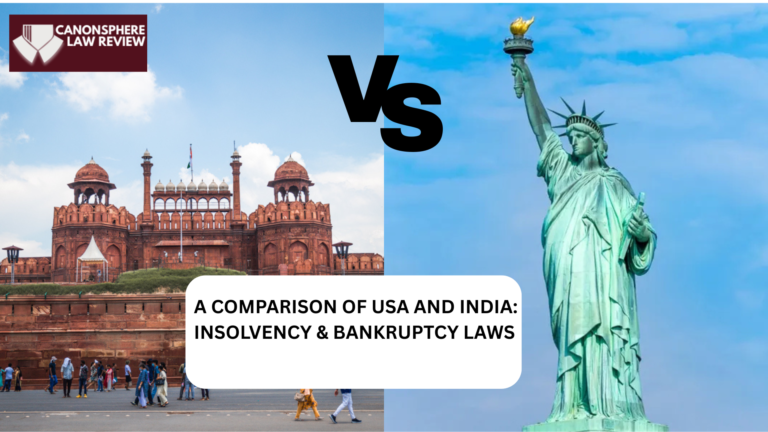
The frameworks for bankruptcy and insolvency in the US and India are compared in this article, with an emphasis on their respective histories, procedural distinctions, and effects on corporate settings. India’s Insolvency and Bankruptcy Code (IBC) of 2016 introduced a creditor-in-control model, where the management of a defaulting company is suspended, and a Committee of Creditors takes charge of the resolution process. In contrast, the US Chapter 11 bankruptcy system follows a debtor-in-possession approach, allowing existing management to retain control during restructuring, which generally supports business rehabilitation and continuity. While the IBC has streamlined insolvency proceedings in India and improved creditor confidence, challenges such as procedural delays, frequent amendments, and limited cross-border insolvency provisions persist. A strong legal system and well-defined procedures for international collaboration, which make it easier to recognise foreign bankruptcy cases, are advantages of the US framework. The practical impact of these variations on stakeholders, such as creditors, shareholders, and workers, are also covered in the study, with a focus on how bankruptcy laws affect market dynamics and corporate risk-taking. It further identifies shortcomings such as India’s need for enhanced judicial capacity, formal cross-border protocols, and procedural consistency, while noting that the US could improve oversight and expedite proceedings to prevent potential abuses of the debtor-in-possession model. Ultimately, the paper argues that both countries can learn from each other: India by incorporating more debtor friendly measures and strengthening international cooperation, and the US by refining procedural efficiency. This comparative study aims to provide valuable insights for policymakers, legal practitioners, and business stakeholders to foster more effective insolvency regimes that support economic growth and stability in an increasingly globalized market

Powered By EmbedPress

This Short article has been written by SOWMYA.A and co- authored by Dr. ARUN.D RAJ. Sowmya and Arun are Law Students at School of Law, Vellore Institute of Technology (VIT) University Chennai Campus, Chennai.

ABSTRACT

This AI-generated content now has a different meaning than that of the machine learning and neural network point of view. This vary technological breakthrough raises challenges and discussions worldwide about what is human and machine creativity. There are different histories of copyright and authorship connected to one another through the case studies of AI-generated works and the disputes created over them. Indeed, the legal situation is beset by a formidable challenge-how do AI-generated content and concepts find a place within copyright law? Differing practices across nations are more than enough evidence that there exist significant gaps in the global copyright guidelines. Integration between governments, companies, artists, and additional parties will be sorely needed to produce frameworks still to come. The benefits of AI-generated content are many, such as increased efficiency, enhanced creativity, better access, and wider diversity among kinds of creative output. And these benefits come hand in hand with aligning the risks it poses-stability versus quality, originality, job displacement, and ethical aspects concerning bias and fair use. The frequency of impacting creators and industries will be unseen; tackling these issues evokes a great deal of active thinking and innovative approaches to achieving commonality in creativity between humanity and artificial intelligence. To follow trends, adaptation always needs to be ensured in the future by working together. Therefore, a holistic approach is significant in understanding and managing AI-generated content towards a restorative and innovative future for the creative industries.

Powered By EmbedPress

This short article is written by Kunda Mulenga, a 3rd-year law student at the University of Zambia. She is a passionate law student who aims to learn and explore laws around the globe.

ABSTRACT

In today’s digital age, where our personal information is constantly being collected, stored, and shared, the privacy policy has become a crucial document that deserves our attention. Whether we are signing up for a social media platform, downloading an app, or making an online purchase, we are often required to agree to terms that govern how our data is handled. Yet, most of us scroll past these policies without a second thought. This emphasizes the significance of reading privacy policies as a proactive step to protect personal information, ensuring users maintain control over their digital footprint in an increasingly data-driven world.

Powered By EmbedPress

This short article is written by Atiya Sanjida, a 4th-year student at the University of Calcutta. She is a detail oriented law student who specialises in Legal Drafting.

ABSTRACT

“Understanding the Different Aspects of Lemon Laws” delves into the legal protections offered to consumers who purchase defective vehicles, commonly known as “lemons.” This short article will include an exploration of the criteria that determine a vehicle as a lemon, the rights of the consumers, and the responsibilities of the manufacturers. It will also cover the legal procedures for resolving lemon law claims and highlight notable case examples. By examining these aspects, the article aims to provide a clear and concise overview of lemon laws and their importance in protecting consumer rights.

Powered By EmbedPress