Canonsphere

CSINv3
Category

Archive

Category

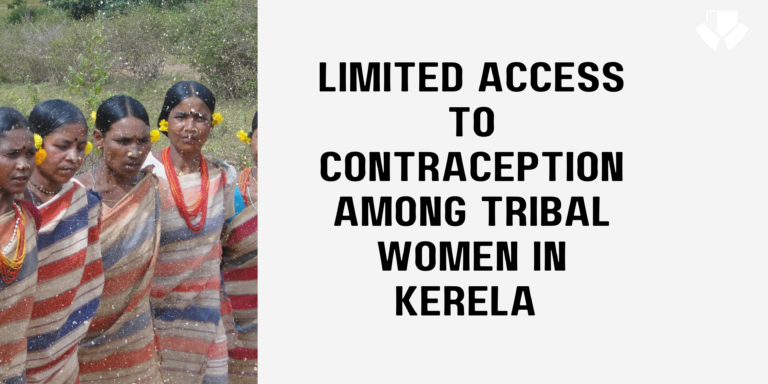
The short article is written by K GOPIKA, an LL.M student at the Department of Law, Central University of Kerala.

ABSTRACT

In the State of Kerala boasts some of the best health indicators in India, disparities in reproductive health persist among its tribal (indigenous) populations.This study analyses the extent of knowledge gaps and low contraceptive use among tribal women, how these gaps are caused by cultural and infrastructure barriers, and suggests focused interventions using data from Wayanad district. A cross-sectional study of 2,495 tribal women from Paniya, Kurichiyar, Adiya, Kattunaicken, and other tribal groups, aged 15 to 49, revealed that only roughly 26.4% of them currently use contraceptives, compared to roughly 58.5% of the rest of Kerala’s population. Key determinants include tribe group, education level, living conditions, and fertility desires; cultural practices regarding menstruation, decision-making dynamics, and infrastructural deficits further limit access; and more than half of the respondents had poor knowledge of contraceptives, with oral contraceptive pill use being particularly low (4.8%). This paper makes the case for culturally sensitive educational outreach, improved service delivery, community participation, and measures to reduce social vulnerability.

KEYWORDS:

TRIBAL WOMEN, KERALA, WAYANAD, CONTRACEPTIVE USE, KNOWLEDGE, FERTILITY INTENTIONS, HEALTH DISPARITIES, CULTURAL BARRIERS.

This short article is written by N. Likhitha Prasad, an LLM Student of Jain (Deemed-to-be-University) School of Law, Bengaluru. 

ABSTRACT

The rapid growth of digital technologies and internet penetration in India has opened up once-in-a-lifetime opportunities for communication, commerce, and governance. However, in tandem with these benefits, cybercrime has reared its head as a serious threat. One of the most noted forms of this phenomenon is called “Digital Arrest” – a sophisticated scam that relies on fear, authority and psychological manipulation to extort funds from unsuspecting individuals. In incidents of Digital Arrest, criminals impersonate law enforcement officers, customs officials, or other government authorities, and individuals are falsely implicated of committing crimes, such as narcotics trafficking, money laundering, or other cyber offenses, and subsequently intimidate them in real time via video calls, surveil them at home, all the while threatening to arrest them or seize their property unless they produce financial payment as falls to clean their name. 

This study addresses the meaning, modus operandi and legal implications of digital arrest scams in an Indian context, as well the various cyber techniques deployed by criminals, ranging from caller ID spoofing, phishing, counterfeit documents to the impersonation of a judicial or law enforcement authority. The paper carefully examines the social, psychological and economic implications for victims of digital arrest, beyond just loss of financial funds, but also severe mental trauma, social dislocation and extreme cases of victim suicides. The legal analysis relies on the  Information Technology Act, 2000, and Bharatiya Nyaya Sanhita, 2023, exploring just how existing laws deal with crimes of cheating, impersonation, forgery, and extortion in digital spaces. The courts and others have reinforced in multiple ways that there is no legal basis for arrest via online means; hence, “digital arrest” can only be viewed as fraudulent. Despite the fact that the government has established a number of channels for victims to report such illegal behavior, notably through the Indian Cyber Crime Coordination Center (I4C) and the National Cyber Crime Reporting Portal and the 1930 telephone helpline.  Despite recent specific warnings to the public, the issue continues to worsen, as seen in reference to the thousands of crores of rupees in financial loss.

This research promotes deeper discussion about the potential to strengthen law enforcement capacity, increase cyber literacy, forge effective international cooperation and establish victim support initiatives through analysis of case studies and statistical information. In conclusion, the study concludes that the challenge of preventing or defending against digital arrest scams will require societal shifts to alertness or resilience that should include legal and technological means as well as literacy in the digital ecosystem, through societal awareness and action.

Keywords: Digital Arrest, Cybercrime, Impersonation, Online Fraud, Cybercriminals

This short article is written by Dr. Puranjan Prasad Paul, Assistant Professor, Faculty of Law, The ICFAI University Tripura

Abstract: The shift into the digital age has utterly transformed the concept of privacy, moving it beyond old-fashioned concerns to face complex new challenges. The core issue is how massive data collection, powerful Artificial Intelligence (AI), and pervasive social media now threaten our personal space. Historically, privacy has evolved from a simple property issue into a recognized fundamental human right. The article highlights key digital dangers: vast surveillance by corporations and governments, the inherent unfairness of algorithmic bias, and the slow erosion of individual freedom through data profiling and the “chilling effect” on free expression. It then examines global legal responses, specifically analyzing the GDPR, the CCPA, and India’s DPDP Act, noting their strengths and weaknesses. To fully protect privacy, the article ultimately proposes a holistic approach involving “privacy-by-design,” demanding more transparency, implementing robust technical safeguards, and fostering international cooperation to secure our data in an interconnected world. 

Keywords: Right to Privacy, Digital Privacy, Social Media Privacy, DPDP Act

This short article is written by CHANDRANI CHAKRABORTY, Legal Research scholar, Motherhood University, Roorkee, Uttarakhand.

Abstract
Artificial Intelligence (AI) is increasingly embedded in social, economic, and political systems. Yet its development and deployment are marked by persistent gender disparities. Women are systematically underrepresented in AI research, policymaking, and corporate leadership, while at the same time facing disproportionate harms from algorithmic bias. This paper interrogates the gendered dimensions of AI through three interlinked themes: (1) women’s participation in AI development, (2) gendered impacts of AI systems, and (3) governance frameworks for inclusive innovation. It traces the historical and structural factors that have led to the underrepresentation of women in science and technology, including educational inequalities, workplace discrimination, and unpaid care work. It then examines how biased training data, opaque algorithms, and unregulated deployment produce discriminatory outcomes in fields such as healthcare, recruitment, predictive policing, and content moderation. Using case studies from the European Union, India, and international organizations, the paper assesses current policy responses and highlights their limitations in addressing systemic inequities. It argues for a feminist framework of AI governance grounded in intersectional data audits, participatory design, algorithmic transparency, and substantive representation of women as co-creators of technology. Such an approach moves beyond tokenistic inclusion and reframes women not as vulnerable subjects but as active producers of AI knowledge. By centering gender justice in AI ecosystems, policymakers can ensure that technological innovation advances substantive equality and human rights rather than reproducing old hierarchies in new digital forms.
Keywords: Women; Artificial Intelligence; Algorithmic Bias; Feminist Technology; Digital Rights; AI Governance; Gender Justice.

This short article is written by Adv Nirvrithy Prasannan s, Advocate, LLM student at Central university of kerala Department of law.                                                                                          

ABSTRACT

One of the oldest and most pervasive systems of social control, patriarchy has historically denied women equal rights and conditioned them into submissive roles. Women have been confined within male-created and reinforced power structures for centuries. Though these roles were frequently framed within patriarchal narratives that glorified their subordination to men, women in ancient times held spaces of reverence as mothers, nurturers, and occasionally as rulers or scholars. Women’s marginalization increased with the introduction of organized religion and the codification of laws. Discrimination against women was institutionalized by social norms, religious precepts, and hierarchical status divisions. By dictating women’s subservience to fathers, husbands, and sons, ancient texts such as the Manusmrithi legitimized male dominance and reduced women’s autonomy to almost nothing. Gender inequality has been sustained across generations as a result of these artificial concepts becoming cultural norms. Education, property rights, political participation, and even basic freedoms were restricted for women. In addition to being accepted as normal, the exploitation and conditioning of women was also defended as necessary to uphold social order. The historical foundations of patriarchy, its social and religious expressions, and its long-lasting effects on women’s rights are all critically examined in this article. It makes the case that breaking down such ingrained barriers calls for a mix of social awareness, legal reforms, and empowerment tactics that go against oppressive customs. Society can move closer to a more inclusive and egalitarian future by dismantling patriarchal ideologies and reclaiming women’s rights.

This short article is written by Divyansha Singh.
Abstract:
The right to equal pay is a vital aspect of human rights, social justice, and constitutional fairness in India. Despite women’s significant contributions across formal and informal sectors, wage gaps and workplace discrimination remain widespread. Recent surveys highlight that nearly one in four salaried women in Indian metropolitan areas perceive a pay disparity, and a significant portion reports experiencing bias in their workplaces. Empirical studies reveal that women in sectors like technology, banking, financial services, insurance, life sciences, and healthcare earn between 19% to almost 30% less than men performing comparable roles. With an economic participation score of about 40.7% and pay parity close to just 30%, India is ranked 131st among 148 countries in the 2025 Global Gender Gap Index, trailing behind neighboring South Asian nations. These statistics expose profound structural challenges such as occupational segregation, systematic undervaluation of women’s roles, opaque pay practices, and persistent biases in career progression and leadership opportunities.
Additionally, intersecting factors including caste, class, religion, and migrant status exacerbate disparities for marginalized women. Addressing these inequalities requires more than legal mandates, it calls for diligent enforcement of laws like the Equal Remuneration Act and Code on Wages, comprehensive gender pay audits, transparent salary policies, workplace reforms, and awareness campaigns aimed at dismantling stereotypes. Closing the gender pay gap is imperative not only for upholding women’s rights but also to foster broader economic growth and social equity in India. Meaningful progress will emerge from combined policy action, corporate accountability, and cultural transformation that genuinely values women’s labor at par with men’s.

KEY WORDS: Equal pay, Wage disparity, Gender bias, Occupational segregation, Pay transparency.

This Long Article has beeen written by Vimala Mary A and Ashelle Dsouza. Vimala is pursuing an LLM in Intellectual Property Rights, Her commitment to service is demonstrated through her coordination roles in the Legal Aid Cell and her receipt of the “Praveen Hrudayaraj” award for exemplary service.

Ashelle Dsouza is a dedicated LLM student specializing in Intellectual Property Rights. She has also co-authored a published research paper on reproductive rights and gender equality.

ABSTRACT

In the age of ubiquitous digital records, the “Right to Be Forgotten” (RTBF) has emerged as a pivotal legal and ethical concept, granting individuals the power to seek erasure or delisting of personal data from search engines and online repositories. This doctrine, crystallized under Article 17 of the EU General Data Protection Regulation (GDPR), aims to balance data subject privacy with competing rights such as freedom of expression and public interest. Yet its implementation faces formidable legal, technical, and normative challenges: how to draw boundaries on which content is eligible, how to adjudicate conflicting rights, and whether the right should apply extraterritorially. Moreover, the evolution of artificial intelligence, data aggregators, and decentralized platforms complicates enforcement and accountability. Ethically, the RTBF raises questions about collective memory, historical record, and the legitimacy of erasing or rewriting digital pasts. Critics caution that it may foster censorship or distort the public record; proponents contend it restores dignity and functional autonomy to individuals besieged by perpetual reputational harms. This study undertakes a doctrinal analysis, tracing jurisprudence (especially the CJEU and regional courts), statutory frameworks, and scholarly debate to articulate a coherent normative and legal framework for RTBF. It probes the scope and limits of RTBF, its tensions with freedom of speech, and the feasibility of cross-border enforcement. The analysis culminates in recommendations for calibrating RTBF in plural legal systems, ensuring that individual redress does not unduly compromise democratic values or historical integrity.

Keywords:Right to be Forgotten, Data erasure, Privacy vs. Expression, Extra- Territorial Enforcement, Digital memory

Powered By EmbedPress

This Long Article has been written by Anam Mackay. Anam is a PhD scholar at Department of Legal Studies, Central University of Kashmir.

ABSTRACT

NALSA and Transgender Persons (Protection of Rights) Act, 2019 have been path-breaking in Indian legal landscape for transgender rights. Almost a decade after the judgement and Act, this paper seeks to highlight the legal changes and legal gaps in transgender rights realisation. The paper uses secondary qualitative methodology for ascertaining the impact of NALSA and Transgender Act of 2019 in recent judicial pronouncements under the broader international and national instruments like UDHR, Yogyakarta Principles and Constitution of India. The paper highlights the lack of legal recognition of civil rights of marriage and adoption for transgender persons and limited access to education and employment despite statutory recognition of the same. The doctrinal analysis concluded that despite international and national framework of rights, transgender persons lack access to rights available to cis-gender persons. It is suggested that courts and legislature ought to work towards fulfilling the commitments under international and national frameworks to provide to the transgender community the basic rights to life by extending civil rights like education, employment, marriage and adoption. 

Keywords- Transgender rights, NALSA judgment, Human rights law, Gender justice, Transgender Persons (Protection of Rights) Act, 2019

Powered By EmbedPress

This short article has been written by Vidhan Dixit. He is a law student at National Law University Chhatrapati Sambhajinagar.

ABSTRACT

Yatra Online’s merger with a U.S.-based SPAC, where SPACs can be defined as Special Purpose Acquisition Companies, are shell entities that raise capital through an Initial Public Offering (IPO) to later merge with or acquire private companies, enabling them to go public without a traditional IPO. Often termed “blank check companies,” SPACs gained prominence in India with deals like Yatra Online’s merger with a U.S.-based SPAC in 2016. However, their rapid growth has raised investor protection concerns due to past fraud cases, such as Nikola Corp. and Akazoo, which misled investors about business prospects. Regulatory bodies like the U.S. SEC and the UK’s FCA have introduced stricter disclosure norms and safeguards, including mandatory escrow accounts and shareholder approvals, to mitigate risks.

In India, SPACs face legal hurdles under the Companies Act, 2013, which mandates business commencement within a year, conflicting with SPACs’ typical 1-2 year target acquisition timeline. SEBI’s stringent IPO eligibility criteria, such as minimum tangible assets and profitability requirements, further complicate SPAC listings. Additionally, tax implications under the Income Tax Act, 1961, pose challenges for cross-border De-SPAC transactions.

Despite these challenges, SPACs offer a faster route to public markets, prompting global regulators to refine frameworks balancing innovation and investor protection. For India to harness SPACs effectively, amendments in corporate, securities, and tax laws are essential, alongside enhanced transparency and investor education to prevent fraud and ensure sustainable growth in this evolving financial instrument.

KEYWORDS- SPAC (Special Purpose Acquisition Companies), Investor Protection, Regulatory Challenges,  De-SPAC Transactions,  SEBI Guideline

Powered By EmbedPress

This short article has been written by Adhya Gupta. She is a Law student at the University of Petroleum and Energy Studies, Dehradun

ABSTRACT

On June 3, 2025, the Securities and Exchange Board of India (“SEBI”) issued Circular No. SEBI/HO/MIRSD/MIRSD‑PoD/P/CIR/2025/82, mandating a streamlined, automated mechanism for the invocation and sale of pledged securities as margin collateral by brokers and trading members. The move addresses persistent inefficiencies wherein invoked securities frequently remained unsold in brokers’ demat accounts, detracting from the intended objective of generating immediate liquidity through invocation. Under the new framework, client‑initiated sales of pledged securities will be executed via a single instruction, “pledge release for early pay‑in”, enabling immediate pledge release and settlement without manual intervention.

When a broker initiates the invocation, the corresponding shares, excluding units of unlisted mutual funds, will be immediately blocked from the client’s demat account for early pay-in. A clear and auditable trail of this transaction will be maintained in the broker’s margin pledge account. A bespoke “invocation cum redemption” process will apply to unlisted mutual fund units, allowing automatic redemption post‑invocation. Additionally, in scenarios where client trading accounts are frozen or restricted post‑pledge, the invoked securities will be moved to the broker’s demat account. and sold under proprietary codes on the same day to prevent accumulation.

These provisions, set to take effect from September 5, 2025, are backed by depositories’ obligation to provide clear operating guidelines by July 1, 2025. Through automation and integration of invocation and sale processes, SEBI aims to eliminate manual delays, enhance operational efficiency, reduce systemic risks, and strengthen investor protection in margin‑based transactions.

Keywords: Margin pledge automation; Invocation‑sale integration; Early pay‑in; Client‑security protection; Invocation cum redemption

Powered By EmbedPress